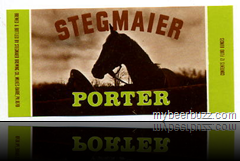
Here’s a cool label, also from the 1970’s featuring Stegmaier Porter. I’m fascinated at how many label variations there are for Steg Porter.
Founder, owner, author, graphic designer, CEO, CFO, webmaster, president, mechanic and janitor for mybeerbuzz.com. Producer and Co-host of the WILK Friday BeerBuzz live weekly craft beer radio show. Small craft-brewer of the craft beer news sites and one-man-band with way too many instruments to play........Copyright 2007-2024 mybeerbuzz.com All Rights Reserved: Use of this content on ANY site without written permission is not allowed.


I can date this one from the mid 1970s to the very early 90s, back when Stegmaier porter was made with Porterine, an additive which gave the product a licorice-like quality which was a unique experience.
ReplyDeleteToday's Steg porter is a vastly superior product that holds much truer to it Pennsylvania roots. Thanks Leo and co.!
i have read repeatedly of the style "pennsylvania porter". what is it exactly? btw the steg porter is probably my favorite american porter. cheers
ReplyDeleteInteresting question....not sure I have an answer but hopefully someone will.
ReplyDeleteAccording to Brewing Techniques dot com (http://brewingtechniques.com/library/styles/sidebars.html):
ReplyDelete"Pennsylvania porter is the classic American porter of the 19th and early 20th centuries. It is a bottom-fermented, ester-free beer with fair-to-medium mouthfeel that will dry toward the end of the taste and may also include slight diacetyl and burnt malt components. Typically, malt and hops are balanced (O.G. 1.049-1.053; IBUs 20-25), and the hops are characteristically American. It is brown/black in color with red tints or a mahogany cast in the glass."
"Certain regional homebrew competitions already recognize what is termed "East Coast Porter." Based on the research presented in this article, this variant could be incorporated into the Pennsylvania porter style."
Somehow I know you would know Sam....Thank you
ReplyDeleteFor what it's worth, I have heard (but can't substantiate) that the porter style had all but vanished from the face of the earth by the 1970s, being brewed in only two places: the Baltic countries and Pennsylvania, and here that means two breweries held on: Yuengling and The Lion. It had supposedly even disappeared from the British Isles by this time.
ReplyDeleteI also disagree slightly with the reference I posted above. I'm sure that PA porter was originally a top-fermented beverage. It was our breweries' choice to switch to bottom fermentation at some point which eventually determined the style they now reference. It could certainly still be PA porter if top-fermented, which I think The Lion went back to when they reformulated the most excellent porter they now produce.
Sam,
ReplyDeleteWhile you are virtually always correct, you are incorrect with the end date of that label. I started drinking steg porter in the mid/late '80's and that label was not around. They had long neck bottles with the foil around the neck and grains on the side. I still have some old boxes. that label lasted until the mid 90's.
The one with the horse you referenced was gone by the mid 80's.
Most eastern PA porters were bottom fermeted, b/c of the problems with keeping two yeast strains. Neuweiler was one exception that was proud of their "real porter" with an ale yeast. along those lines, yuenglings chesterfield ale is really not an ale, as they use a lager yeast strain.
That being said, I really did like the "old" steg porter with the licorice flavor. Like the modern day and still drink it but that one was unique and amongst the thousands of porters around today, none taste like it.
Humility keeps one honest, Lee. I appreciate the correction. Maybe it's my perception of when I thought the changeover had been made that's got me confused. I thought that by the time the foil had been added, the porter had been de-licoriced, but that could be incorrect. You're compulsive enough to have saved the bottles, so I ain't gonna argue!
ReplyDeleteOld-timer's disease strikes again!
Well it's all relative. Having never tried the all-out horse label licorice version, perhaps the foil bottle version seemed like it *was* de-licoriced to you. I came in on the foil version and I noticed some licorice flavor, but not like the "old timers" have reported it being, basically licorice in a bottle. The only time I got that is when Legacy in Reading did a porter that supposedly mimicked the Old Reading Porter of the 50's and it had mucho licorice.
ReplyDeleteWish I had the chance to try the Legacy version. Was it a one-off?
ReplyDeleteNo, they actually promoted it fairly heavily but it didnt last. When it first came out it was real licoric-ey then they toned it down subsequently.
ReplyDeletebtw, i am guessing it was legacy, it may have been neversink... pretty sure it wasn't fancy pants.
It said on the menu that it was based on the Reading porter from the '50's